Showing posts with label Tasmania. Show all posts

Monday, 22 July 2019

When I think of historic Tasmania, I think of Richmond first. We first came to Tasmania way back in1985 and Richmond is what I remember the most. It certainly wasn't as busy and as commercial as it is now.
Located 27km from Hobart, Richmond was one of the first areas explored after settlement at Risdon Cove in 1803. Coal was discovered in the area and the river therefore became known as the Coal River. With the establishment of Hobart in 1804, the district became an important stop on the route from Hobart to other parts of the colony. Settlers were encouraged to settle in the area and in 1823 the Richmond bridge was started. The Coal River was often difficult to cross in times of flood, a high bridge was needed. It is said to be the oldest surviving large stone arch bridge in Australia, and was originally called Bigges Bridge after the Royal Commissioner, John Thomas Bigge, who recommended it be built. It was built by convict labour and made of sandstone quarried from nearby Butchers Hill, and completed in 1825.
Richmond was built as a convict settlement and the town was named in 1824 after David Lord's Richmond Park Estate which adjoined the settlement. As a convict settlement the town needed a goal, barracks, magistrate, and courthouse. The town has over 50 colonial buildings, although most are now private residences.
The streets are laid out in a grid fashion, so it is easy to walk around the village.
St John's Roman Catholic Church is the oldest church in Australia that is still used. A short walk from Richmond Bridge, the church is Gothic in style and is the usual rectangle shape of most churches, and located on top of a small hill overlooking the village. With over 1000 Roman Catholics in the area by the 1820's, Richmond had the highest Roman Catholic population outside of Hobart and Launceston. The establishment of the church was lead by Australia's first Roman Catholic Archbishop, John Bede Polding, while visiting Richmond. He persuaded local landowner John Cassidy to donate a portion of his land for the new church. The foundation stone was layed in 1835 and was blessed by Archbishop Polding before he left Tasmania, and money was raised for the construction of the church by both the public and the government. The church was completed in 1837. Additions were made in 1858 and were adaptions to the original design were made by convict Frederick Thomas, who later became an architect.
The inside is beautiful, with stained glass windows and old fashioned pews.

A sad story is the grave of the infant son of the Irish rebel leader, Thomas Francis O'Meagher. Henry Emmet Fitzgerald, aged 4 months, died in 1852 and his father never saw him. His mother, Catherine Bennett was a local colony girl who while travelling to Ross to be governess to six children of Dr Hall, was introduced to O'Meagher who came to help when their carriage was trapped in a ditch. A friendship followed and lead to marriage in 1851 at the home of Dr Hall. His father Thomas, was an Irish Political exile. He found living in Van Demons Land to restricting and escaped to America early in 1852. Catherine, a free settler, was to follow later after the birth of their child. Henry was born and contracted influenza and died at only 4 months. Catherine left for America to join her husband, only to find that O'Meagher had changed. She spent three months with her husband, only to leave for Ireland when she with child. She lived with her father in law in Ireland who loved her like a daughter. Catherine died, aged 22years, soon after the birth of their second son - Thomas Meagher III - and she is buried in Ireland. The second son also never met his father, died in the Philipines and is buried there. Their father, who became Governor of Montana, drowned in 1867 and his body was never recovered. A sad story with all four family members being buried in different continents. Henry Emmett Fitzgerald O'Meagher's grave is located at the front left had side of the church.

Looking like a castle turret, St Lukes Church has hardly changed since being completed in 1835. Constructed by convicts from local sandstone (Butchers Hill). Designed by John Lee Archer with the interior woodwork designed by convict James Thompson (who was pardoned due to the high quality of his work), the church took a while to complete. The church was closed for some time due to the decaying of the interior and money was raised for restoration.
The Richmond Arms is the only remaining pub in the village. Built on the land of the original Lennox Arms (1830) which also served as the Post Office and offered groceries. It was a stopping place for travellers passing through and as well as a meeting place for locals. It was sold to Cascade Brewery in 1879, and was destroyed by fire in 1888. Cascade quickly rebuilt the hotel and called it The Commercial Hotel. It was renamed The Richmond Arms in 1972. 
So many beautiful buildings and gardens. There are a lot of cafes and craft shops, and of course antique shops. A place to go back to go.

Tuesday, 4 June 2019

Ross, Tasmania's Heritage Village

From Campbell Town it was an easy short drive to nearby historic Ross - Tasmania's Heritage Village. Situated by the Macquarie River the area was first surveyed by the first Government Surveyor Charles Grimes in 1807, and by 1812 a small garrison of soldiers were stationed in the area. The town slowly grew and in 1821 the village was proclaimed and named Ross by Governor Macquarie. Ross was the parliamentary seat of his friend H. M. Buchanan of Scotland. The original wooden bridge was replaced in 1836 and constructed of sandstone. It is the third oldest bridge in Australia.
We easily found a parking spot in the main street and went for a walk. There are very few information boards in the village, other than the odd 'Heritage Listed' plaque and framed newspaper articles, so a little homework is needed. It is said that the four corners of the centre of the village depict Temptation; Damnation; Recreation; and Salvation.
TEMPTATION - Man O’ Ross Hotel was established by William Saddler in 1835 and was built by the convicts. Constructed from local, hand cut sandstone, it is believed to be haunted. Today it still operates as a pub with accommodation and food.
DAMNATION – Originally the Town Gaol, today it is a private residence.
RECREATION – town hall c1880.
 SALVATION - Roman Catholic Church, c 1920.
 Next to the church is the old Barracks c1827, and now a private residence.
There is a lovely walk along the  river from the bridge in both ways.
Over 40 historic buildings can be located in Ross. St John's Sunday School, c 1847, a beautiful sandstone building. The present building was rebuilt in 1902.
We had to stop at Bakery 31 and get one of its famous scallop pies.
Ross Bakery Inn, dates from the 1830's and was convict built for John Dickinson, an English free settler. Originally named Sherwood Castle Inn, a coaching inn, built of local sandstone, and is listed on the Tasmanian Heritage Register and the National Trust. The original bakery, alongside, has operated for over 100 years on the site.
A little further up the road is St John's Church of England, built in 1868 and contains a 100-year-old pipe organ and stone pulpit. Te church was locked so we couldn't go in to look.

Every where one looks is historic.
There is a new construction of a park in the centre of the main street, which will be great when finished.
The Post Office was built in 1896 and completed in 1889 with a verandah with twin cast-iron columns. Exploring inside there are many interesting trinkets, both new and old. Jonnie was fascinated with the old telephone.
At the top of hill near lookout is the Uniting Church c1885 has beautiful blackwood pews and pretty stained glass windows.
We then drove around to site of the convict Female Factory c1848-1854, thinking it was further away than it was. It would have been an easy walk from the old bridge or the Uniting church. A very interesting building - the only original one remaining - with heaps of information not only about the building but also about the people who once lived there.
Here is a really cool interactive map of Ross here. We spent the whole day here and had lunch and afternoon tea at the bakeries.

Thursday, 23 May 2019

Along the Heritage Highway - Campbell Town

The Heritage Highway runs from Launceston to Hobart in Tasmania. Our first stop was beautiful Evandale, and a short 40 minutes away was Campbell Town, famous for the convict built Red Bridge. There were a lot of roadworks going on to widen the road along the highway, however the delays are not long. We stayed at Campbell Town a few times on our trip, as it is a good central location and also we knew Blackburn Park was a great free camp. Located at the southern end of the town next to the Elizabeth River, and near the Red Bridge, the campsite is peaceful, except for the odd train that liked to blow its whistle at the nearby train crossing. This is a free permit camp, and like Evandale, a two day permit must be obtained. It is a lovely large grassed area with a little shade, but no facilities, other than a few tables and benches. It is walking distance to supermarkets and cafes. There were a few happy campers there, but there is so much space there was plenty of room.
View from our window.
Also nearby, across a pedestrian bridge from Blackburn Park, is Wardlaw Park where a collection of chainsaw sculptures that depict the history of Campbell Town can be seen.
Campbell Town is another 'convict' town. The information centre, located at the north end of the main street, was closed each time we were there, I guess the lack of volunteers leads to reduced opening hours. That is the reason we pick up information on all different towns when we visit each info centre. Campbell Town was named by Governor Lachlan Macquarie in 1821, after his wife’s maiden name of Campbell. It was established as a garrison town in 1826, one of the four garrison towns linking Launceston and Hobart. The Elizabeth River is also named after Governor Macquarie's wife.

Blackburn Park is located near the famous Red Bridge, believed to be the oldest brick arch bridge in Australia. It was completed in 1838 and has over 1.5 million bricks all hand made by the convicts.
We made daily visits to Valentine Park, and the close by cafĂ©’s. The park was part of the Grange property, and named after the owner. An interesting park worth a visit. There are toilets and picnic tables, some in the shade of big beautiful trees. There is a statue of Eliza Furlong and a ram, this is a sheep farming region. Born in Glasgow, she married wine merchant John Furlong. After the death of four of their six children, they were advised to move to a warmer climate. Eliza and her sons studied sheep and the wool industry and decided to move to New South Wales. They collected many sheep from different farms around Saxony and in 1829 William and the sheep set sail. The ship stopped at Hobart for supplies and William was offered land to start a wool industry, which he did. In 1831 Eliza and the family joined him on his property, Winton, just north of Campbell Town. Elizabeth died in 1859.
Also in Valentine Park is a monument to commemorate the Transit of Venus. In 1874 the transit of Venus was viewed from Campbelltown, one of eight official observation sites in the world. It was again viewed in 2004, and 2012. The next viewing will be around 2117. The beautiful Grange in the background, hosted parties for astronomers who visited for the Transit. The Grange was built in 1847 as an English manor house. It was designed by Everard James Blackburn and was the home of Dr William Valentine who enjoyed astronomy. He hosted a party for the United States Naval Observatory who  came to witnessed the Transit of Venus in December, 1874.
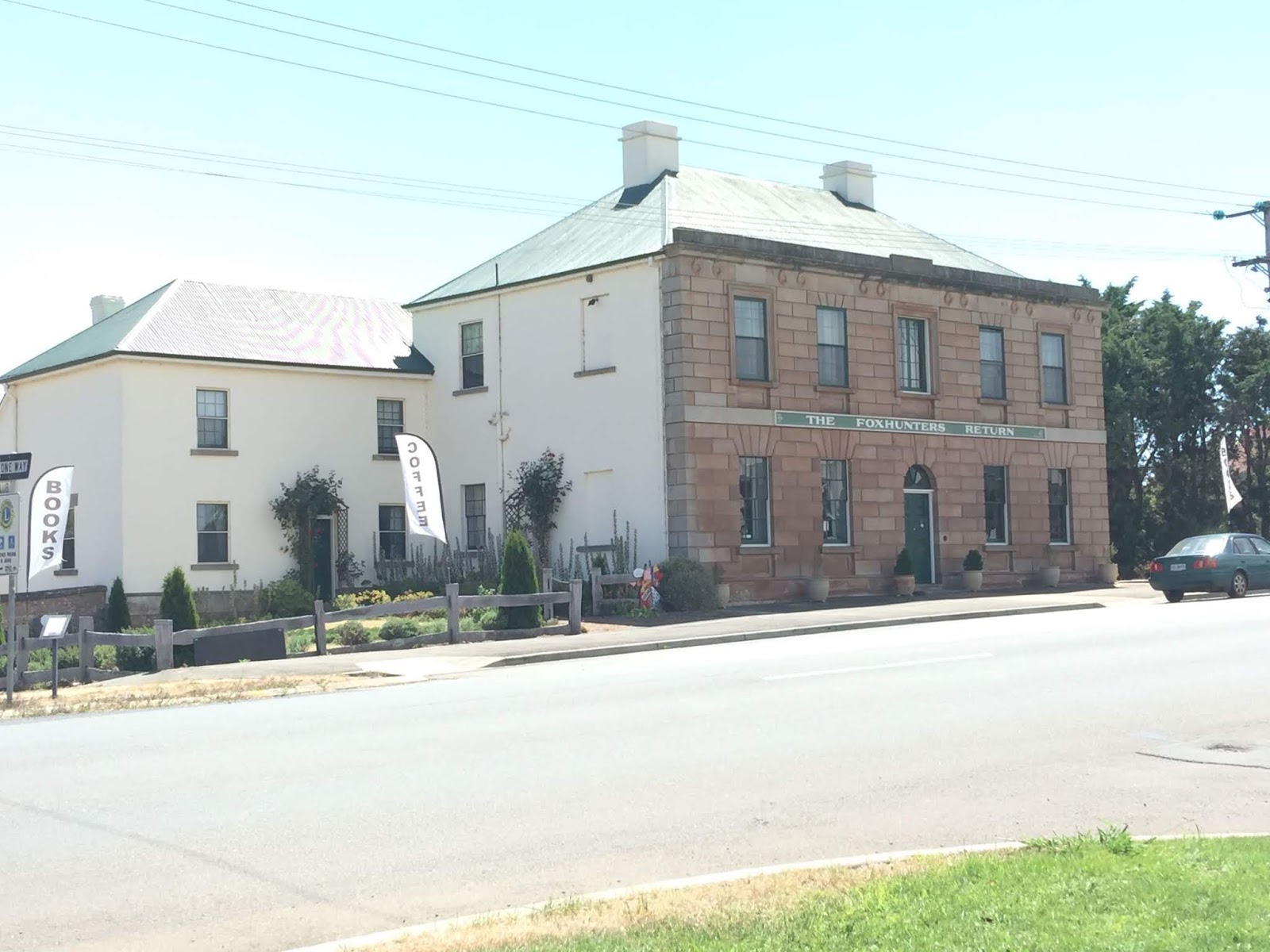
There is a Convict Brick Trail which is a line of red bricks running up the main street from the Foxhunters Return, an old coaching inn dating back to 1833. Designed by stonemason Hugh Kean, and constructed by convicts, the inn is National Trust listed, and is described as "the finest and most substantial hotel building of the late colonial period in Australia." The inn is now a accommodation place with the cellars now a book store open to the public. The cellars are where the convicts were housed during construction and also a typical inn cellar. The Brick Trail is a single line of bricks with each brick depicting the lives of every convict that reached Australia. We had a look at quite a few but didn't find our PERRETT convicts - really need more time. The brick had the convicts name, age on arrival, the ship and year they arrived in, their crime, sentence, and a little comment. There are over 2,500 bricks – no we didn’t count them, a local told us. 
There are a lot of cafes and antique shops, but it is the historical buildings that we like. The old Campbell Town Inn, also designed by Hugh Kean was built in 1840, is a grand building that now houses an antiques shop, and cafe. It is across the road from Valentine Park.
The towns first Methodist Chapel was built in 1839 and was located behind this second Methodist Chapel built in 1846. The first chapel was built from funds raised by the congregation, and soon out grew its congregation. The first church behind became the residence for the caretaker. By 1880 this chapel too became too small and a new Wesleyan Brickhill Church was built in the main street - which is now for sale, and this building became a Sunday School. Today I think it is a private residence - so beautiful.   
The Wesleyan Bricknell Church - for sale.
There are just so many beautiful colonial buildings in Campbell Town.

Monday, 29 April 2019

Heritage Highway - day trips from Evandale

Being based in Evandale, we were close to many of the heritage villages and the heritage listed buildings of Brickenden, Woolmers and Clarendon. We did a day trip to Perth, Longford, and Cressy. 
Perth is 10 minutes drive from Evandale and 20 minutes from Launceston. It  was the first main town out of Launceton, heading south toward Hobart. Governor Macquarie first passed through the area in 1811, and the first settler was Thomas Massey (Chief Constable of Launceston), who established a farm in the area in 1814. Macquarie passed through the area again in May 1821 and it was he who chose the site as a town and named it Perth after the town in Scotland. A military post was established and a ferry service ran across the South Esk River. Te town was surveyed and laid out in 1833. By 1834 there were two hotels and eight houses in the town and a school was under construction. Nearby were two flour mills.
The Leather Bottell Inn, (55 Main Street) dates back to 1830's and is one of the oldest buildings in Perth. It as named after a hotel in Kent England that Charles Dickens would frequent. A bluestone and rendered brick construction with cedar fittings, it has been a post office, boarding house, restaurant, antique shop and a private residence. At the rear of the building a police cell has been restored and re-erected from Scone Street.  
There are many examples of Georgian Cottages and.........
....some quirky buildings too.
Less than 10 minutes from Perth is Longford. We were able to get a carpark right next to the First Settlers Cemetery and the Anglican Christ Church. From here, the centre of town it was easy to do a circuit walk past the historical buildings, although some of notes on the self-guided tour were confusing. We picked up a town map at Evandale Info Centre.
The church has a beautiful stained glass window, that we were unable to see as the church was locked. Lieutenant Governor Sir John Franklin laid the foundation stone in 1839, and the church was built of sandstone. We walked through the first settlers cemetery, which was interesting. An audio tour can be purchaced from the council offices. The church yard is an arboretum which was planted 1830's with the intention of planting every tree mentioned in the bible. We didn't check.
The area was originally known as Norfolk Plains, and then Latour, but it is unknown why the name was changed to Longford, but the change came around the same time as the Longford Hotel was established. The heritage listed buildings, and there are many, also have a plaque attached.
The Longford Hotel was built in 1827 by Newman Willett. It has been a bank, a library, a livery stable, a doctors and also a temperance house. It is now an antiques shop.
Heritage Corner was also built in the 1830's. Previously called The London, and The Plough Inn and had a skittle alley at the back. It has been many things over the years, but now is a cafe.
Longford is also the home of Australia's oldest continuously operated racetrack, established in 1846. In 1959 and 1965, the Australian GrandPrix was held in Longford. A display can be seen at the Country Club Hotel. After our walk around Longford, it was time for lunch. We headed a little further south to Cressy, the home of trout fishing. We found a lovely little park with tables and chairs in the shade. Cressy was named by Bartholomew Boyle Thomas after the battle of Crecy - a battle between the English and the French in 1346. Thomas was an early settler who was granted 20,000 acres in the area. The first building was the Cressy Hotel in 1845.