Showing posts with label Eden. Show all posts

Monday, 4 July 2022

Killer Whale Museum - Eden NSW

Killer Whale Museum - Eden NSW, is famous for telling the story of Old Tom, whose skeleton has pride of place in the first hall of the museum. Driving up from the port of Eden towards the town is the purpose built museum for Old Tom.

The skeleton of Old Tom was found on September 17, 1930 by Allie Greig. This prompted the construction of the Eden Museum, a place to showcase not only the story of Old Tom, but also the whaling industry and the history of the area. Tom's body was processed at Davidson Whaling Station and local businessman, John R Logan set the scene for the construction of the museum. A committee was formed and the building was completed in 1938 and Old Tom installed in 1939. Unfortunately Logan passed away late 1937 and never saw his vision complete. The outside walls now have beautiful murals on them depicting the local history.

There is a small car park at the top of the hill outside the entrance, and the view is spectacular, a great place to sit and enjoy, especially if one has walked up the hill.

Eden was the site of the first permanent shore-based whaling station, so it is relevant that a Whale Museum is located there. Old Tom was an Orca - Orcinus Orca (aka Killer Whale) - and preyed on Baleen Whales. The first hall is all about Old Tom and first whaling stations. It is the only full skeleton of a killer whale in the Southern Hemisphere.

There is also the original capstan from Davidson Whaling Station (we saw the replica there).

There are many halls dedicated to different aspects of whaling and the history of the area. The Katungal Aboriginal people had a unique bond with the killer whales and there is a small area dedicated to this part of the history. However, much of the Aboriginal history is written about in many of the different halls.

Killer Whales, or Orca's are one of 35 species of the oceanic dolphin family and are believed to be about 11millions years old.

After the introduction hall, with Old Tom and the history of whaling in the area, we went to the theatre hall and saw a very informative film of the history of whaling in the area.
Upstairs is mostly the history of whaling in the area.
 Downstairs is mainly the history of the area, the timber getting, the gold rush, and the farming and exploration.
There were two areas, one upstairs and one downstairs that were closed, getting ready for new exhibitions, and the lighthouse was closed.
There is a good gift shop and the volunteer staff were very knowledgeable. There is no cafe or food available, but a short walk down the street one will find places to eat and drink.
Cost was $15 per adult and it was well worth it, especially if one wants to know about the local area history. It is probably better suited to adults who like to read as there is so much information available. We spent just over two hours there, and saw a few children that were bored.

Monday, 27 June 2022

Davidson Whaling Station

  We stayed at Ingenia Holiday Park just south of Eden and travelled the short distance of 30 mins - 29km, to the Whaling Station. We went to have a look at Boyd's Tower first, but the road in was closed. So off to the Davidson Whaling Station.
Located on the Kiah Inlet at Twofold Bay, Davidson Whaling Station was the longest running shore-based whaling station in Australia, and the last of its type to close. It is a short walk from the car park to the old dwellings, now a private residence, ....
.... and another short walk to the ruins and the beach.

This is where the Davidson family set up their home and whaling station. Three generations of the Davidson family operated this station using traditional bay-whaling techniques using open boats and hand held harpoons. They were also assisted by a pack of killer whales, or orcas, who would drive the Southern Right and Humpback whales up onto the beach. The area has interpretative signs and easy walkways.

The Davidson home, named Loch Garra, was built about 1896 and is situated on 17 acres of freehold land and was planted with fruits, vegetables and beautiful gardens. The family of 10 : George and Sarah, and their eight children, Jack, Effie, Roy, Sarah, Jim, Wallace, Elsie and Carrie also had chickens and dairy cows making the family mostly self sufficient.

However, that was not the first house on the property. In 1857 Alexander Davidson, George's grandfather, built Kiah House opposite from where Loch Garra was built. He built the house using material from the shipwreck of the Lawrence Frost. Kiah House was destroyed by fire in 1926.
The Whaling Station was established by Alexander Davidson in 1826 and was built using equipment purchased from the failed Ben Boyd whaling station. The Davidson's used green coloured boats, the colour of the traditional Davidson tartan, and used harpoons instead of guns. It is believed the orcas could recognise the green colour and as the harpoons were quiet they felt safe to help the whalers. Remnants of equipment can be found throughout the property.
A short walk from the homestead along a wooden boardwalk and dirt path takes one down to the beach on the left and the old whaling equipment on the right.

The Orca's would spot a whale and head to the station to alert the whalers by slapping their tails on the surface of the water, known as flop-tailing. The whalers would head out to the location, guided by the orcas. The orcas would 'corral' the baleen whales towards the whalers, where they were harpooned until they died. The next day the whalers would pull the dead whale back to the station using metal ropes and the assistance of the orcas.
At the station the whale was processed. This a replica of a whale winch, a capstan, which was used to hold the whale carcass in place while the blubber was being striped.
Thick layers of blubber  were removed and boiled in water until the oil rises to the top. The oil overflowed into gutters and into try-pots to cool before being put into barrels. The off cuts were thrown on the fire to keep the water boiling. Try-pots had been in this bay back in the 1840's when a Hawaiian man, Otaheti Bill, set up his try-pots in the bay.

The oil was used for lighting and soap. The try-works was last used in 1929, and fell into disrepair. The whalers would only catch about 8 whales a year, and only the whales that the orcas had been naturally hunting. The local Aboriginal people observed the nature of the killer whales, orcas, and developed ways to benefit from their behaviour. George Davidson also learnt from orca behaviour and used it to his advantage. The Davidson Whaling Station operated until 1932. George Davidson and his family lived in Loch Garra until 1945. There is so much information at the Eden Killer Whale Museum.

Entry into the Whaling Station is free, and well worth a visit. Take a picnic lunch and enjoy the beach.

Monday, 20 June 2022

Benjamin Boyd and Boydtown, Eden area, New South Wales

The town of Boydtown was established by Benjamin Boyd in the 1840's. Boyd was born in London in 1801 but lived most of his early life near Newton Stewart in Scotland. In 1825 Boyd became a member of the London Stock Exchange where he worked in shipping and commercial exchanges. In 1840, after sending ships to Australia to trade, Boyd became interested in purchasing land in Australia and setting up his own enterprises. Financed by the 'Royal Bank of Australia, Boyd and his brother James, set sail for Sydney in 1841, arriving on July 18 1842. Boyd straight away launched a number of different enterprises using his own money and the banks money. Hw set up a steamer operation between Sydney and the south coast. This encouraged both settlers and goods to relocate to the south coast, Melbourne and beyond.

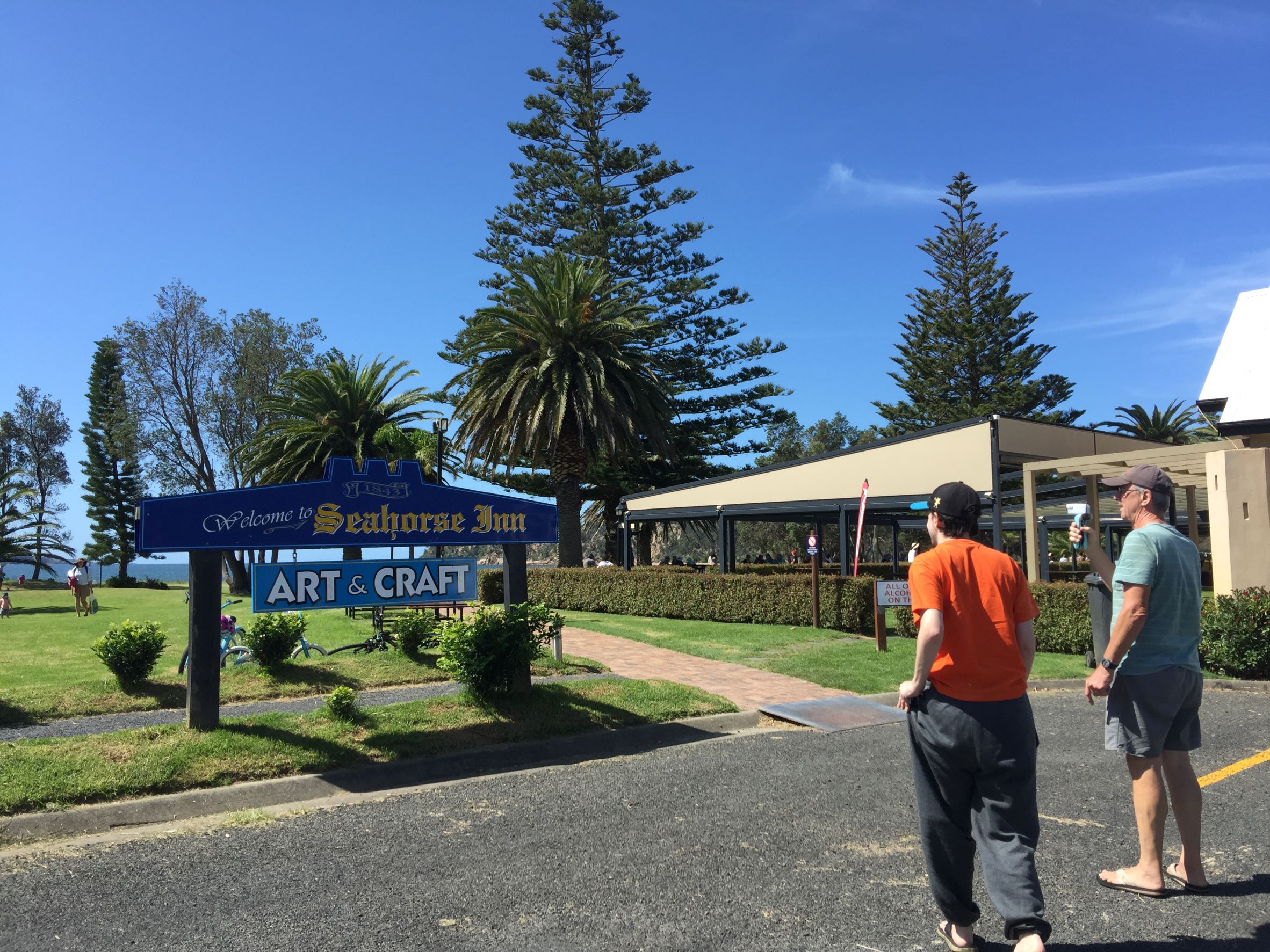
It was on one of these voyages in 1842, that Boyd remained in Twofold Bay and set up a whaling camp. The first whaling settlement in the area was at Snug Cove, Eden, in 1828. Boyd named the town after himself, and attempted to make Boydtown the centre of his whaling and shipping businesses. He built cottages for his many workers,  Using Boydtown as his base for his many expanding enterprises, he built a 300 foot long jetty, Seahorse Inn, lighthouse tower, a church, stores and many workers cottages. Situated on Nullica Bay, today the Seahorse Inn remains, although not in the same form that Boyd has wanted. There is a long sandy beach and beautiful green lawns - great for picnics.

By 1844, Benjamin Boyd became the largest landowners in the colony. However, even though he used lowly paid indigenous and islander workers, his holdings were affected by drought and the 1840's depression, he over extended himself and found himself in financial difficulties. In 1847 Boyd lost control of his enterprises and by 1849 the Boydtown operations were closed. At this time, Boydtown had a population of 400 and Eden only 49. Most of the buildings Boyd had started were left incomplete, and he was in financial ruin. He left Australia in October 1849 and headed to the Californian goldfields. He failed at that and was last seen October 1851 on San Cristobel Island in the Soloman's, going game shooting.

The Seahorse Inn as it stands today, is a luxurious boutique hotel, with a Brasserie, saloon bar, cocktail bar, and function centre.

Boydtown is also a stop on the Killer Whale Trail, and tells the story of the original whalers, the first people, The Katungal group, who lived on this land and had a special understanding of the whales.

Boyd's Tower is located on the headland to the south of Boydtown. The road into the tower was closed due to bush-fire damage, and the more recent flooding damage, so we couldn't visit the tower. Located in Ben Boyd National Park, the tower was built between 1846 and 1848 as a lighthouse and whale watching tower, but like most of Boyd's constructions, was never completed. Boyd wanted the lighthouse to only be used for his own ships, so permission was never granted. It did make a good whale watching tower. A much smaller replica stands out the front of the Seahorse Inn.

The remains of Boyd's church is located to the right of the front of the Seahorse Inn, and was never consecrated or used. 

Today the area consists of the Seahorse Inn, a caravan park, and a new residential area. Discussions are ongoing about a name change due to the acknowledgement of Boyd being responsible for taking advantage of the local indigenous population in the construction of the town, and Boyd's relocating of islanders to work on his land.

Monday, 13 June 2022

Eden, New South Wales. PetalliTravellers

Eden is situated on the Sapphire Coast at Twofold Bay, Southern New South Wales, about 470 kms from Sydney on the Princes Highway. We stayed a short 7 minute drive from Eden township at Ingenia Beachfront Holiday Park. We wanted to explore the area, a sort of reconnaissance, for when we come back on a cruise. Yes, it is a cruise ship destination.
So first stop was the Information Centre now re-located to Snug Cove at the Cruise Ship Wharf. Since 2014 cruise ships visiting have been a regular occurrence rather than occasional. To meet the requirements, in 2019, the wharf was extended to approximately 110m in length.
The new Eden Welcome Centre was started in March 2020 and opened in April 2021 and has been waiting for cruise ships to be allowed to visit Australia again.

A beautiful building, with heaps of information about the area. The staff were knowledgeable and so helpful answering all our questions. This new building has a small art space/gallery and a covered outside area which we were told would house market stalls on cruise days.

We were also told that a courtesy bus/es would provided transport up the hill to the town centre,  and return. We will do that, catch the bus up to town, have a walk around (probably have some oysters) and then walk back down to the cruise ship via Warren's Walk off Imlay Street. Bob Warren, a local fisherman, lived at the top of Warren's Walk and one assumes he would walk down the hill to his fishing spots. His house and sheds, although maintained as heritage buildings, were destroyed by gale force winds. The walk is approximately 600 metres and zig-zags past gardens with spectacular views across the port.
Like many NSW coastal towns, Eden has a rich history. First inhabitants were the Tharwa people of the Yuin Clan who lived on the coast from Malacoota in the south up to Merimbula in the north. Captain Cook is believed to be the first European to sight Twofold Bay in 1770.
First Europeans in the area were whalers and sealers as there was evidence of their camps in the area. In 1797, George Bass noted and named Twofold Bay as he passed through. In October 1798, Matthew Flinders and George Bass on their voyage to Van Dieman's Land, sailed into Twofold Bay to find shelter from the strong winds and decided to explore the bays.  They landed on 10 Oct 1798 and named Snug Cove, as a safe haven for shipping vessels. Together they named many of the places around the bay.
The first Australian shore based whaling station was established at Snug Cove in 1828, by Captain Thomas Raine. Whaling in the Eden area continued for the next 100 years, ceasing in 1930. It became the longest continuous shore based whaling operation in the world.
Eden's first buildings, slab huts, were erected about 1833 by the Imlay Brothers at Snug Cove. By 1834 the Government of the time gave permission for a town to be established, but nothing was done until 1843. Several other whalers followed including Benjamin Boyd in 1842. He took over from the Imlay brothers and established and built Boydtown to the south. Boyd wanted Boydtown to be the main shipping and service area and in 1844 built a post office. His plan was not to be, and he went bankrupt and left Australia.
 
 
The first liquor license was granted in 1845 to James Rixon of the Crown and Anchor pub on Imlay Street. It is Edens oldest surviving building and is now a bed and breakfast. Edens first post office was opened in 1847 at the Great Southern, built the same year. Originally a store, it became a hotel in 1880. Balconies were added later. 
The PO then moved to the Crown and Anchor and various other buildings until 1891 when a purpose built building on the corner of Imlay and Mitchell was built. It operated as a post office until 1971, when the PO was moved up to a new building next to the Australasia Hotel. A red phone box still sits at the front of the old PO.
1857, the first government school was started with 12 girls and 30 boys. Eden was named after George Eden who was the British First Lord of the Admirality.Around 1900 Eden was suggested as a future national capital as it had the third deepest harbour in the world.


Eden has many many historic buildings and trails to experience the history of them. Information pamphlets are available at the info centre - I did have to ask for the town walk one. Eden Heritage Walk and drive takes one on a walk through the town. All sites are numbered and the walk takes in amazing views.
Howard's Store, located on Imlay, was built around 1904 by Matthew Howard, who sold motor vehicle oils, parts and tyres. Today it is heritage accommodation.
Hotel Australasia was built in 1909 however was not a licensed hotel until much later. It was known as the largest and most modern building in Eden at the time. It was known as the 'Sanatorium of the South Coast.
The Half House was the first two story house in Eden and was built in 1850. It is known as the 'half' house as the planned extension was never completed. It was used as a Post Office until 1885, and then used as an office of the Government Savings Bank. It is now a private residence. 
The Whale Dreaming Trail starts at Snug Cove and has signage to learn about the traditional owners and their relationship with the whales. The trail continues up Warrens Walk along Imlay Street to the Eden Killer Whale Museum. The views are spectacular.

I will have more about Eden Killer Whale Museum here in a later blog. 
 
This is part of a much longer walk, The Bundian Way, which is gradually being updated to provide safer walkways. It follows the path of Aboriginal migration to follow food sources. Only sections are open now.
 
The Killer Whale Trail covers Eden and surrounding areas. It is better to drive this trail. It takes in 5 historical sites and during whaling season each site can have great views of the whales.
There are board walks: one along Lake Curalo, which is about 3.5km from the cruise terminal at Snug Cove, and meanders around the lake, a 6km return; and Aslings Beach Maritime Walk, a 1.5km from Snug Cove starting at the Historic Cemetery, a 4km walk along the boardwalk to Lake Curalo. There are murals and plaques and information boards all along the pathway.
Killer whales have played an important part in the history of the Eden area. Whale watching in Eden is from mid August, when the whales are heading north, to the beginning of November. The best time to go is September and October when the whales are heading south. Cat Balou Cruises do Whale Watching in season and also a Twofold Bay Highlights Cruise. We are  thinking of doing that when we cruise to Eden in November. Cost at present booking direct is from $50 per person and the cruise is about 2 hours. 

There are heaps of oysters farms in the area. We had a great lunch at Wheelers at Pambula. They usually have tours but the tours were not running (due to 'C') when we were there, tours cost $24 per adult.

Another oyster tour is Captain Sponges Magical Oyster Tour (also closed while we were there) also takes one on a cruise down the Pambula River, samples included. Prices are $70 adult. For those travelling by caravan, there is an oyster tour one can do visiting many oyster farms over as many days as one wants, or has time for. Really lovely oysters in this area.

Just so much to see in and around Eden.

  • beautiful scenery and walks
  • historic buildings
  • beautiful beaches
  • fishing
  • Killer Whale Museum
  • Mary McKillop Hall 
and further afield:
  • nearby towns of Pambula and Merimbula 
  • Green Cape Light House 
  • Davidson Whaling Station
  • Boydtown
  • Ben Boyd National Park
  • Boyd Tower

Not to mention some surprise finds around town.

A beautiful, beautiful area that we will return to.