We stayed at all three free or donation camps near Ballarat, and this
third camp at Haddon, is where we met up with fellow caravaners,
Caron and Pete. We first met Caron and Pete in Maclean, NSW over a
year ago, and we have kept in touch. It was great to catch up with
them again, and as we are both planning on the same places at roughly
the same times later in the year, we are sure to catch up again.
Ballarat has two festivals this time of year: Begonia Festival, and
White Night. White Night is like Sydney's Vivid, and it covers the
historic city centre area. We thought about going as we were here on
the night, but the cold and the crowds put us off. We did go to the
Ballarat Botanical Gardens.

The first week we were in Ballarat was just before the Ballarat
Begonia Festival and most of the gardens were closed to set up, so we
came back a week later. So glad we did. The gardens were beautiful.
The Ballarat Begonia Festival is held every March and is free. The
Festival has food stalls, live entertainment, talks, markets, and
heaps of activities for kids. A bonus during the festival is free
park and ride, and free vintage tram rides. We were fortunate that the main begonia display was still there.
We have never seen so many huge begonias.

With the discovery of gold in 1851, the area grew rapidly. In 1856
a committee was formed to create a botanical garden, and in 1858 the
old police horse paddock was converted the gardens. The 40 hectacre
site was divided into three sections:- the central planted section;
and a clear open area each end. There was once a zoo also located
there. The gardens have lovely statues – Ballarat is known as the
city of statues – all with a story. One of the statues is of
William Wallace depicted standing on Abbey Craig in Stirling in 1297.
It was meant as a tribute to James Russell Thomson and his Scottish
heritage, and at the time of its creation in 1889, it was believed to
be the biggest statue in the Southern Hemisphere.
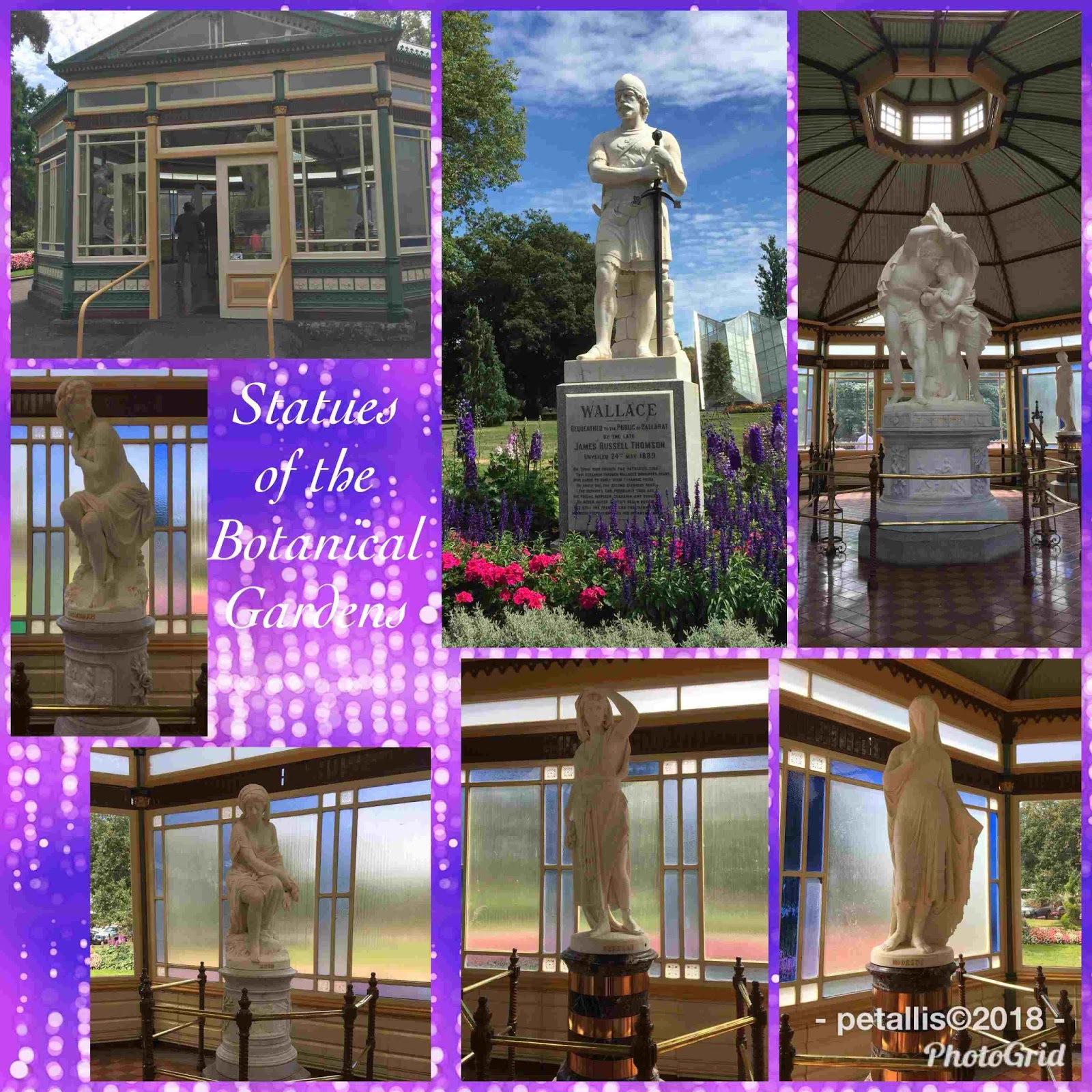
There is a display of 12 white marble statues that came from Italy
in 1884 and were gifted by Thomas Stoddart. It was his gift that
inspired many others to follow making Ballarat a city of statues.
Also of interest is the Avenue of Prime Ministers. Some were very
recognisable and others not so. One needs to get the free brochure
available at the gardens to get more detail of each Prime Minister.

The most moving part of the gardens was The Australian
Ex-Prisoners of War Memorial. Located just inside the gates at the
southern end, the memorial was officially opened in 2004 and contains
all known names of Australian POW's from the Boer War - 193; WW1 –
4,220; WW2 – approx. 31,600; Korean War – 31; Military Nurses –
61; and Merchant Navy – 245. It was a very moving place and so
beautifully done. All is made of stone and water (sadly most of the
water has been turned off – drought). There is a log pathway with
stone on one side and native plants on the other. The stones list the
names of the POW's. The pathway is made to look like railway sleepers
and in the centre of the stone names is a large row of stone obelisks
to act as sentinels overlooking the POW's forever. Each sentinel has
the names of countries where the POW's were held. There is a fallen
sentential to symbolise those that have fallen as POW's. A very
visual and moving memorial.

The Arch of Victory and Avenue of Honour are located not far from
the Botanical Gardens. The Avenue is 22 kilometres long and is the
longest commemorative avenue in Australia. It is located on the road
to Burrembeet. The idea for the avenue came about in 1916 to honour
those who enlisted in Ballarat to serve in WW1. Fund-raising and
donations lead to 3771 trees being planted by 1919 – one for each
local soldier, sailor, airman and nurse who served in WW1. Over the
years other memorials have been added to the avenue as well as more
trees. Bronze plaques have also been added with the names of
servicemen. The Arch of Victory was officially opened by the Prince of Wales
on 3 June 1920. It took only three months to build the grand entrance
to the Avenue of Honour. It stands 17.4 metres high, and 19.5 metres
wide.
More details can be found at: www.honouringouranzacs.com.au
The Garden of the Grieving Mother is located to the left of the
Arch of Victory. It is a new garden, officially opened in 2017 by
Governor General Peter Cosgrove. It commemorates the mothers and
families of those who lost loved ones in the war. Of the 3,801
servicemen and women honoured in the Avenue of Honour, 742 soldiers
and 2 nurses gave their lives. Those that did return often suffered
from physical and psychological wounds that also impacted on the
families. The statue was created by sculptor Peter Corlett. The
garden is still being improved and is a fitting memorial garden.

Other things to see in and around Ballarat include MADE – Museum
of Australian Democracy at Eureka, is the home of the original Eureka
Flag and is located on the site of the famous stockade. Cost is $12.

Did you know at the age of 60 years, Mark Twain visited Australia,
including Ballarat in 1895.
The weather turned windy a few nights, but the days were lovely. We went to the Smythesdale
historic area markets, and then had a look at a few other historic features of the area: Scarsdale, Historic Bridge, and Jericho Historic
Gold Mine.