Showing posts with label Derby. Show all posts

Monday, 25 October 2021

Horizontal Falls, Western Australia - May 2021

We were in Derby to do the Horizontal Falls overnight tour. Found in Talbot Bay, in the Kimberley's, the Horizontal Falls is a natural phenomenon in the ancient McLarty Ranges. We had researched all the different Horizontal Falls tours for months before even starting this trip, and as we didn't know when we would actually get there, we didn't book until late. We had no problem getting a booking. There are a few different sellers, and the flights leave from both Derby and Broome, at different times. We chose Horizontal Falls Adventure, overnight tour, expensive for us but a once in a life time experience. We got the seniors discount and the RAC(Q) discount, and it was still the cost of a 6-7 night cruise but it was worth it - as I said, once in a life time. The staff we spoke to, Bonnie and Sarah, were so helpful and went out of their way to assist us, being three of us, and most cabins being for two. We were picked up around 2pm from the caravan park, did the flight safety video, boarded the small planes in groups, I think there were three planes, and flew over to the falls. I was surprised we were not told to wear masks on the plane, as we were on the Lake Argyle flight. The sites we flew over were spectacular.
We flew over the falls a few times.
On arrival we were shown to our cabins.
We were booked into a three berth cabin, but as there was a spare cabin, Peter and I were given a double, and Jonnie had the 3 berth at the front of the pontoon. Bonus. The rooms were basic, a bed and a small set of drawers, small and with air-conditioning. We didn't spend a lot of time in the room, literally to get dressed for dinner and to sleep.
We next put on our life jackets and went in the jet boat to visit the falls. We were only able to go through one of the falls, as the other fall was too dangerous to go through.
David Attenborough called the Horizontal Falls 'one of the greatest natural wonders of the world'. The area has huge tidal surges up to 10 metres with the force of millions of litres of water through two narrow gorges, one of 10 metres and the other of 20 metres. 
Back at the pontoon, Peter changed to go swimming with the sharks. Not many were wanting to do this, Jonnie and I didn't. We were told about the sharks and the other sea creatures that live in the inlet, including the crocs.
We then boarded the jet boats again for a trip along the river, a much slower pace. 
Arriving back just before sunset, to get ready for dinner.
The pontoons are linked and there are two, two story pontoons and other attached smaller pontoons - including a bar and a pool and a helipad. After refreshing in our cabins, we went to the bar area for pre dinner drinks and snacks. This tour is a BYO alcohol and provided are water, soft drinks - Soda Stream - tea and coffee. Soda Stream drinks needed to be pre ordered before our slow boat trip. We didn't do that, but should have for Jonnie. We had taken Coca-cola and beer and scotch. We went to the pre-dinner drinks and snacks, only to find very limited seating and very few snacks left.  I made a plate for the three of us to share, and we took it upstairs to the dining area to eat.
A little disappointing, but the sun set was amazing. My drinking view.
Dinner was a buffet, baramundi, boiled potatoes, beans, bread rolls. It was ok, not spectacluar, not what one would get on a cruise, but ok.
Dessert was good, didn't take photos, but was good. We met some lovely people and talked to almost midnight. One thing I thought we would see was the beautiful stars, being so far away from the town light, but there were no stars.
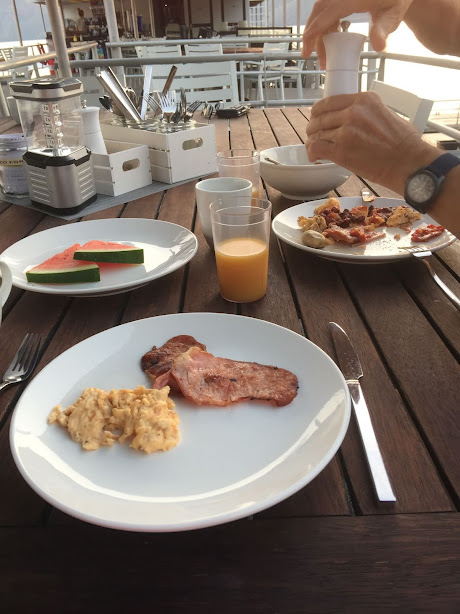
Early morning breakfast was great, scrambled eggs, bacon (not crispy like I like it), mushrooms, grilled tomatoes, fresh fruit, juice, tea and coffee. A very nice breakfast (for me missing was pancakes 😉) 
A lovely way to start the day. My drinking view ....
We then boarded the jet boats for another go through the falls. This time the tide was changing and the falls were very flat, and we were able to go through both falls. We did see a croc on the other side.
It was then back to the pontoons, bags were already loaded onto the planes and were headed back to Derby, flying over the long curved jetty.
It was easy to see the vast mudflats from the air.
Arriving at our van site about 8.15am. A really good trip, a lot of money, but worth it. Petallitravellers has two Youtube videos for our visit to the Horizontal Falls.
Tourist season is from March through to October. The temperatures, although still hot, are bearable and the wet season has finished. With the season halted by the cyclone Seroja, we were the second group for the 2021 season. I was aware of the tides and knew that the falls are caused when the tide falls fast, and we wanted to see 'falls' fall, so we chose dates appropriately. A too low tide and the falls will not be noticeable, a too high tide and the boats will not go through.  

Thursday, 21 October 2021

Derby, Western Australia - May 2021

We had booked a Horizontal Falls overnight trip for the 17th May, and had 10 days to do short daily trips, plenty of time. Pulling up at a beautiful off road campsite and just finished lunch, we got a phone call 'up grading' us to two cabins the week earlier, on the 10th, so we now had 3 nights to travel 650km from Purnlulu National Park to Derby. We decided that two days were needed at Halls Creek to explore the area and to visit Wolf Creek. That gave us one overnight before arriving at Derby.

After leaving Halls Creek, we travelled to Mt Hardman, just past Fitzroy Crossing, 381kms - a long day, stopping at Mary Pools - a beautiful free camp - for lunch - that we had planned on staying at for a few days ...

... and then at Fitzroy to get milk and bread. Mt Hardman was on three different levels. We started on the top level and moved to the middle level when a tour bus left after having afternoon tea.

From Mt Hardman it was 170km to Derby. We stopped for lunch at a huge tree (maybe a boab tree?) at Nyikina & Mangala, home of the Yimardoowarra people.

The caravan park, Kimberley Entrance Caravan Park is huge and most of the sites are big. We liked the different murals painted on the buildings around the park, and the white peacock/peahen that visited each afternoon. The park was good, except for the high price - that's why we opt for low cost camping.
We arrived, un-hitched and had a drive around town. Derby is very spread out and there is a lot of history there.

Located on an ancient sand dune on King Sound, Derby has the highest tides of any Australian State.  It has a beautiful curved jetty that is best seen at sunset. 

After the high tides, come the low tides and the mudflats that one drives past for minutes before getting to the jetty. We were fortunate to see locals net fishing in the receding tide.

Before European settlement the Worrorra and Nylkina Aboriginal people inhabited the area. Derby was the first town established in the Kimberleys in 1883 and was named after Lord Derby, Edward Henry Stanley, the Secretary of State for the Colony. When gold was discovered in the Halls Creek area in 1885/6, thousands of prospectors arrived at Derby by ship. The first jetty was a short wooden t-shaped jetty built in 1885 and at low tide the prospectors had to walk through the mud to get one of the 5 hotels. The jetty was upgraded and extended in 1893s and a horse drawn tramway was built to cross the mudflats with passengers and goods. The oldest building is the wool shed at the edge of town and it is the only remaining part of the old port. The current jetty was built in 1964 of concrete and steel and some of the tram tracks can still be seen in parts. Passenger ships ceased in 1973, and the port closed in 1983, only to be reopened again in 1997.

At the beginning of the jetty is a beautiful Community Mosaic Tile Floor housed in an open gazebo. The first time we saw it there was a couple sitting in the middle watching a movie on their tablet. Never seen that before. We went to the jetty a total of three times while we were there, just to see the different colours and water. Luckily the last time we went the mosaic was clear so we were able to take photos. The floor is 28 square metres of tiles - over 28,000 tiles - that took 370 people 800 hours. It consists of 8 themes: the land, the sea, wet season, dry season, pre-settlement, pioneering, people, and industry. The original design concept was evolved by Mark Norval and Pam Masters. The names of the creators are listed on an information board inside the gazebo.

Just 7km south of Derby is Australia's longest cattle water trough. The original well was sunk in the early 1890's by Alfred Duckworth Myall and was fed by natural bore water until the windmill pump was built. In 1910/11 the bore was extended to over 300ft deep with a trough of about 15-18ft. It was originally built to water the cattle while the drovers stopped for the night before going into Derby the next day. In 1916/17 a concrete trough was built 120m long and could feed up to 500 bullocks at a time. Not long after that, as the water flow lessened, a windmill was constructed to pump the water. The bore water is mineral rich and was said to have therapeutic properties, so a bath house was built nearby.
A short walk away is the Boab Prison Tree, known as Kunumudj. With a girth of 14.7m, it is believed to be around 1,500 years old. It is registered as an Aboriginal site and is culturally significant to the local Nyikina people. It is also important in the early history of Derby township and was used as a staging point for prisoners being walked into Derby gaol. It is on the WA State Heritage Register.
Leaving the long trough, and the prison boab tree, we came across Frosty's Pool so stopped to have a look. It was built in 1944 as a bathing pool for troops stationed in the area. It was built by the 3rd General Transport Co. and was nicknamed Frosty's Pool after Charles L.V. Frost. It would have been filled with the mineral waters from the trough, and was one of many in the area at the time.
Located on the main street that leads to the jetty (hard to know what is actually the main street in Derby), is the old gaol. Built in 1906 by prisoners, behind the police station that was built in 1896, the old gaol is all that remains of the old police area.
Built of a concrete floor and an iron frame with one side of corrugates iron and a thick mesh and iron ceiling, the structure is safe from termites, and weathering, but was in danger of decaying over time until in 1988 the National Trust classified Old Derby Gaol.
The gaol was intended for temporary accommodation only, but some prisoners were held up to 6 months or more. The treatment and conditions were horrendous and it is hard to believe people could do this to other people.

Derby is also the end of the Gibb River Road. There is an interesting self guided driving tour called the Pigeon Heritage based on the life of 19th century Aboriginal tracker known as Pigeon, that takes in Windjana Gorge and Tunnel Creek, but both were closed while we were there.

The next day we were heading to Horizontal Falls. The caravan park had no discount for the van being stored there, not using any power or water, and the airport didn't have facilities for storing a van, so we had to pay for three nights van park accommodation, even though we only really stayed two nights, and stored the van for one and at $58 per night, it was disappointing. After the day and night at Horizontal Falls, and a late night and early morning we were back in the van, had a nap, and just relaxed with other happy campers. One meets so many lovely people while travelling. We left the next morning heading for Broome.

Saturday, 23 March 2019

SCOTTSDALE – North East Tasmania


Our next camp was at North East Peoples Park, a donation camp run by the local Lions Club. What a great camp, clean toilets, showers, drinking water and set in a beautiful park. The Park is named after Charles Northeast, who initiated the concept of a park for the people in 1930. The park was opened in 1935 with a swimming carnival and over 1000 people attended. The park is a beautiful open space with ponds and gardens and is part of the North East Tasmania Rail Trail. There are platypus in the river, and although we looked each afternoon we didn't see any. We only intended staying a few days at Scottsdale, but with the bush fires raging in many parts of Tasmania in January, we stayed put until we were sure it was safe to travel the Midland Highway.
Scottsdale is only 20 mins from Bridestowe Lavender Farm, and 1 hour from Launceston. The area is a timber cutting area, but many farms and dairies can also be found in the surrounding district. Originally known as Cox’s Creek, Cox’s Paradise, Hazelwood, Hazelton and Ellesmers, the town is named after James Scott, the Government Surveyor who cut the first track to Cape Portland through the area in 1852. He noted the rich soil in the area. The first inhabitants were the Pyemmairrener Aboriginal people. The first Europeans to settle in the area were Janet and Andrew Anderson were they took up a holding near Bridport in 1833.
We packed a lunch and drove up to Bridport, about 20 minutes north and known as the Gold Coast of Tasmania and is a summer vacation area. It certainly is a beautiful area. Named as it is located on the port of the Brid River, and was proclaimed a town in 1883.

Located on Anderson's Bay, we found a lovely spot. It was a bit windy to walk along beach.
From Bridport we did a circuit drive along the coast through the conservation areas to a golf course - one of two here, then took Old Waterhouse Road back to Scottsdale.
Another day trip was an inland circuit from Scottsdale to Derby. First stop was Ledgerwood and the beautiful avenue of WW1 memorial tree carvings. These trees were planted in 1918, one for each of the 25 fallen men from the town. A report in 2001 said the trees were unsafe, and by 2004 it was decided that each tree would be carved into the likeness of each soldier by Eddie Freeman. This is also a donation camp for self contained vans. We also went to have a look at the free camp at Ringarooma, just down the road. Both were good, and a good alternative to Scottsdale, which did get crowded during the week.
Derby was the location we chose for lunch. Once a tin mining town that was devastated by Briseis Dam disaster and floods in 1929, however still retains some of the old buildings. The area was surveyed by James Scott in 1855, but it wasn't until the 1870's, when settlers were looking for gold, that tin was discovered in 1874 by George Renison Bell. In 1876 a mine was opened by the Krushka brothers and named The Brothers Mine. The town grew around the mine. In 1887 the name of the town was changed to Derby, perhaps after the Earl of Derby, Edward Smith-Stanley, who had been the Prime Minister of Britain from 1866-1868. Derby today is a mountain bikers heaven with numerous trails.
Not far away is the town of Branxholm, also with a donation camp. The Imperial Hotel was built in 1907.

An interesting area on the Tale of the Tin Dragon Trail which tells the history of the area through Chinese history in Australia. Along with the discovery of tin, came the Chinese miners.
Taking some little back roads we went through some lovely farming land. This area is known as the heart of the ‘Bible belt’ of the Exclusive Brethren. We had heard about an Amish Tea Room, just off the main highway to Launceston, and it was just like being in the Amish Pennsylvanian tea rooms. 
The small café is surrounded by veggie gardens and fresh produce is also sold. Inside the tea rooms are bolts of fabric and notions and finished patchwork bags, wall-hangings, mats, and small quilts. I did buy some scrap bags.
We had scones, tea, (Devonshire tea $5.75) milkshake ($4), and apple slice ($4.50) – all homemade on site without electricity. I have no idea how the milkshake was kept so cold, but it was.
 On yet another day we drove into Launceston to go to Spotlight and Anaconda. We had been told the main road to Launceston from Scottsdale was not really the best for caravans, and it wasn't. When we did finally leave Scottsdale we took another road that went around the mountain and came into Launceston from the north. We did this circuit drive. At the top of the range is this beautiful lookout, where we had lunch.
 On a clear day one can see Flinders Island.
We stayed 6 nights at Scottsdale, before heading to the Midland Highway - looking every afternoon for the elusive platypus.