Showing posts with label Northern Territory. Show all posts

Tuesday, 17 August 2021

Timber Creek, Northern Territory - April 2021

Back to Katherine overnight and then a long drive into Timber Creek – about half way, and 290km. We stopped a couple of times to see sites along the way. One was the road train memorial of the crossroads of the Buchanan Hwy and the Victoria Hwy.

So hot so we had a fruit break - all the fruit needed to eaten before Western Australia.

We also drove through the spectacluar Gregory National Park, named after Augustus Charles Gregory, an early explorer, and second largest National Park in Northern Territory. A beautiful area with colourful ridges and boab trees, another place we want to go back to.

Situated on the Victoria River, this was our last stop in Northern Territory before crossing over to Western Australia. There are two caravan parks situated behind the two adjoining petrol stations. There is also a free camp down by the river, but there was a fishing competition on that weekend so it was pretty full. We camped behind the second road house as it was cheaper. A good camp site with grass and space around each site. 

There is a lovely park area, a small pool and a pub with an overpriced food menu, but it is on a creek with freshwater crocs, so no swimming. The site was large and at $35 a night not bad value.

The first inhabitants were the Nagaliwurra and Nangali peoples. Timber Creek was named in 1855 by Augustus Gregory who used the timber from the banks to repair his boat. That night Peter and Jonnie and a few other happy campers went spotlighting for crocs (I was watching footie - my team won).

Filling up the car the next morning, and admiring the station mural, we only drove a short distance to our first stop.

Not far from Timber Creek is the Gregory Tree. This is a boab tree on the banks of Victoria River where there are marking of Gregory’s expedition from October 1855 to July 1856. Over a period of 8 months Gregory and his expedition team explored the Victoria River catchment area and this became one of the longest overland rides. Their overnight stays are recorded on the trunk of large boab trees.

We continued our journey from Timber Creek towards the Kimberley region of Western Australia. We had lunch at Saddle Creek, an overnight free camp, and what a great camp at the base of an escapement that I would assume changes with the changing sun. If we hadn’t had Covid Border passes for 1 May, we probably would have stayed here a night or two.


Monday, 9 August 2021

Litchfield National Park, Northern Territory - April 2021

We chose to base ourselves in Adelaide River and did a one day trip to Litchfield via Batchelor, 40 minutes each way. Our first stop was Batchelor, steeped in history. Goyder's survey party passed through the area in 1869 and in 1874 the roadhouse, Rum Jungle was constructed to supply travellers with a meal and drink on their travels.
The surrounding area was part of a farm owned by Mr. E.L. Batchelor. A section of the farm was set aside for the town with the arrival of servicemen during WWII. By 1949 and with the discovery of uranium, Australia's first uranium mine, the town began to flourish. There are information boards explaining the WWII history.
The information centre is tiny, but has enough info on the town. A walk around the town is interesting with many information boards with the history of the buildings. 
On the way out we came across a park with a model of a castle - above. This model was built by Bernie Havlik during his retirement. He was annoyed  by the large rocky granite outcrop, so he built a miniature replica of Karlstejn Castle from his birthplace, Czechoslovakia. It took him 5 years to construct. It was Bernie who established most of the towns pine trees and mango trees.

There is a caravan park just outside Litchfield and we saw this unusual planter out the front. There are also camp grounds within the park.

Litchfield National Park covers about 1500 sq km and has been formed by water over thousands of years. The park is named after Frederick Henry Litchfield who was a member of the Finniss Expedition. The area was once a tin and copper mining area, and became a national park in 1986, and was opened in July 1991. There is a sealed road that runs through the park and all the attractions can be found off this road, many also on sealed roads.

We passed a number of termite hills on the way into Litchfield and stopped at the large Cathedral Mound. 

The other side of the parking area are the magnetic ant hills. Photos don't show the configuration very well. They are built in a way to allow the least amount of surface area to be exposed to the heat from the sun. Very clever. Looked very much like headstones.

We also visited a few different water holes and went swimming in Buley Waterhole. 

A little way down a rocky path, to the waterholes was worth the walk. The steps were very slippery and there were quite a few people there.

Next stop was Florence Falls. There is a walk from Buley Water hole to Florence falls, but we drove. We walked down to the lookout to see the falls and Jonnie wanted to go to the bottom, so I went back to car to do my crosswords and Peter and Jonnie went down the 135 steps to the base of the falls.

Next stop was Tolmer Falls, named after Frederick Litchfield's late fathers friend, Alexander Tolmer. 

It's a 500m walk to the lookout. There is no access to the gorge as there are protected species in the gully. 

The one I was looking forward to, Wangi Falls was closed due to a croc sighting. 

Also closed was the cafe, where we had planned to have lunch - lucky we had fruit and carrot sticks to eat. Wangi Falls are the largest falls and the most popular, probably because they are next to the camping grounds. We still had a walk down to the falls - spectacular. We also had a walk around the camp ground. Looked pretty good and only a short walk from the falls.

Historic Blyth Homestead, off Sandy Creek Road, was built in 1929 by the Sergeant Family. It was abandoned in the 1960's and is now a tourist attraction. The road was closed due to flood damage, so we were unable to go. So much history we missed.

 
PetalliTravellers on YouTube: Adelaide River and Litchfield Park

Adelaide River, Northern Territory - April 2021

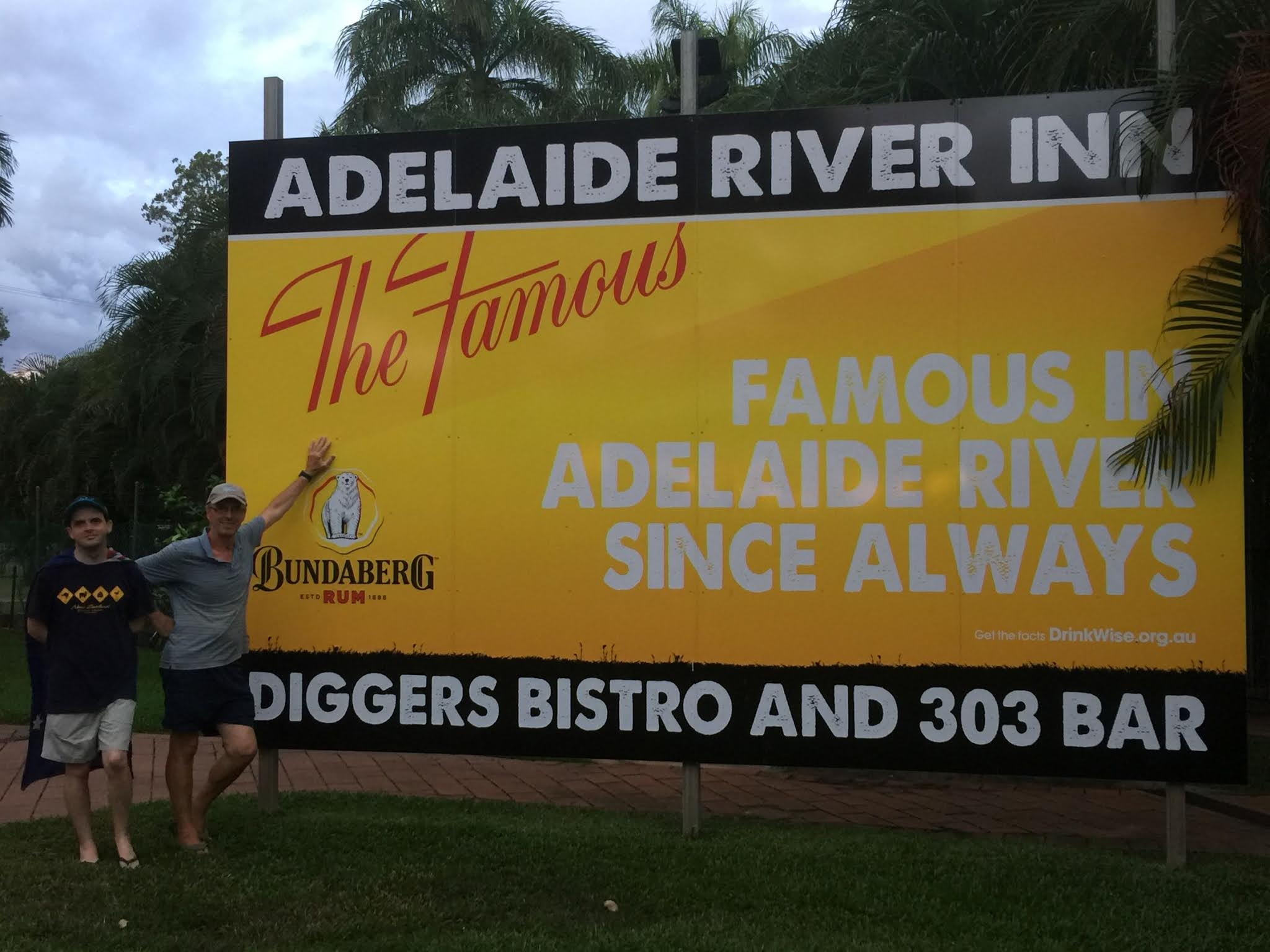
We stopped at Adelaide River for lunch on our way from Katherine to Darwin, and thought we would come back to visit Litchfield National Park from Adelaide River rather than from Darwin. There are two caravan parks in Adelaide River, one is at the showgrounds, a little out of town, and the other is behind the historic Adelaide River Pub on the main street, at $28 a night. It has two camp kitchens and a pool. We had a grassy site next to the road to the war cemetery. The food at the pub was ok, as were the prices.

There is a huge beer garden, petrol station, and bistro. Located on the Stuart Highway, the pub is famous as being the home of the Crocodile Dundee water buffalo. Apparently the buffalo came from the Adelaide River area, and it is now preserved in the pub.

As the park is an un-fenced park, I had my own experience with a vary alive water buffalo. We were setting up after arriving and through the window I saw a water buffalo casually walking down the footpath.

I grabbed my camera and went outside to take a better photo. Big Mistake! I stood to the side of a bottle tree and as I raised the camera to take the photo, the buffalo lowered his head, pointing his enormous horns in my direction, snorted, and charged at me! I jumped behind the tree, and told Peter the buffalo charged at me - AND at the same time I realised there was only a small bush between me and the charging animal. Peter heard the charging, opened the van door and said get inside quick. I looked at the bush and there was the buffalo staring at me not even a metre away. Talk about scared!! I jumped in the van, we signaled Jonnie to get back into the car, and Peter watched the buffalo walk slowly around the car. No one at the park believed there was a buffalo there until we showed them the photos. Well that was an experience. Jonnie and I spent the rest of the time wearing black, just in case we should see another one.

The first peoples in the area were the Kungarakany and Woolna people. The first Europeans to explore the area were Lieutenant John Stokes and Masters Mate L.R. Fitzmaurice in 1839. They named the river after Queen Adelaide, the widow of King William IV. In 1862 John McDouall Stuart passed through the area - the highway is named after him.

The first settlers came as workers on the overland telegraph in 1871, at the same time gold was discovered around pine Creek and as miners travelled through the town, the town grew. By 1886, the construction of a railway line between Darwin (then known as Palmerston), and Pine Creek. The rail bridge and railway station were completed in 1888-89. Today the historic railway precinct, can be found on the south side of town and houses many photos and much memorabilia of the old railway days. We were hoping to see the Ghan travel through, as the tracks are still used.

 The main attraction in the town is the war cemetery and relics of WWII. 

After the bombing of Darwin, Adelaide River became the headquarters of a large base and the war cemetery was created for the burial of servicemen and women who died in the Darwin bombings.

The cemetery is looked after by the Commonwealth War Graves Commission, and they are doing a great job. Next door is the civil cemetery, where 63 civilians were killed in the bombing of Darwin. 

There is also a memorial to those Australian forces lost in the Timor Sea and Northern Australian waters.

We did a drive on some dirt roads to find the remains of the hospital and the base buildings, with little success. We did find ruins, but nothing to say what they were.

We used Adelaide River as a base to visit Litchfield National Park. The town also has a grocery store and police station. 

See PetalliTravellers YouTube video on Adelaide River and Litchfield Park.


Thursday, 29 July 2021

Darwin surrounds - April 2021 part 2

We only spent a week in Darwin, and did something every day. Just so much to see and do in and around Darwin. 

We did a day trip to Howard Springs to see the Orchid Lady, the quarantine centre and the recreation area. I was hoping to see a lot of tropical orchids, but they were far and few between. We had heard some bad reports about the Orchid Lady, but we went to look for ourselves. The place looked very over grown and didn't appear to be open, so we kept going. The Howard Springs Quarantine Centre was interesting to see. Very well organised and keeping us safe. Well done NT for doing this and not hotel quarantine - as it obviously doesn't work as well!

Howard Springs Recreation Park was originally developed during WW2 by Australian and American servicemen as a recreation camp.

The weir was built in 1944 to improve the pool for swimming. If you look carefully you can find markings from the servicemen that built it.

There is a toddler pool and playground built near the weir and a lovely park to walk through with picnic tables. There is a kids rock pool walk that looks fun and there were a lot of kids playing on it. 

 
Next we went to Humpty Doo and didn't really see what was so good about it. There is a jumping croc cruise, and a good pub, but that is about it. Oh, and a 'big things' crocodile.
 

On the way back, along the highway we stopped at Strauss Airfield, which runs parallel to the highway. We noticed the life size cutouts of the planes when we were driving into Darwin. This landing strip was used by Australian, American, and British pilots during the war. We drove into and around the bush beside the runway and saw all the cleared spots where we assume the planes were stored under the canopy of the trees. Very interesting, and would make a perfect bush camp - except for the signs that say no camping. Sadly there was evidence that people had stayed there - toilet paper and old campfires.  

Peter wanted to see the Ghan Railway station - we will travel on the Ghan one day, so we headed out to East Arm. Not a lot to see at the railway station, it was rather underwhelming. I had my 'Defence of Darwin Experience App' turned on, it shows WWII sites in the Darwin area, and there was a Quarantine Anti-Aircraft Battery nearby.

We followed the signs and the app and found what was left behind some trees. It is not hidden, but would be easy to miss if one didn't know about it.

The roof of each structure is gone but the surrounds and accompanying information boards give one a good idea of how it all worked.

It is the most complete aircraft battery in the Darwin area, and it helped to defend the Darwin Harbour.

There was also a silo art nearby.

Jonnie wanted to see crocodiles. It has been many years since we have taken him to see crocodiles, so out of the two crocodile parks in Darwin area we chose Crocodylus Park at Berrima, mainly because it had a 'croc cruise'. So we planned a day trip and wouldn't you know it, the cruise was cancelled due to the boat needing maintenance.

Well another place/activity to add to our list of sites closed. The park itself was good anyway. There are a lot of crocs to see, and we saw the croc feeding twice. 

The park has many more animals, lots of Australian animals but also meerkats, funny creatures, and apparently white lions. We looked and looked for the lions in their enclosure and finally found one asleep in the shadows under a tree, didn't look white, but.......

Jonnie held a baby freshwater croc.

The reptile museum was very good, and cool inside away from the outside humidity.

We missed the Mindil Markets by a week, but drove through the park both during the day and early evening. Would have been interesting to see the transformation into a market. We had to do a sunset from Darwin so went to Nightcliff Beach with some snacks and waited with everyone else for the sunset. It was amazing.

After sunset we drove through the city to see what was lit up, and we were not disappointed.

There are just so many different tours and experiences in Darwin, many centering around the bombing and WWII. We liked it so much we will come back.