Showing posts with label Western Australia. Show all posts

Monday, 30 October 2023

Gnomesville, Western Australia

We saw Gnomesville on a segment of a TV travel show and put it on our list to visit. We were not sure what we would find - TV shows can be very misleading. It was only a slight detour from where we were going - Wellington Dam - and was one of about four detours we made that day. I thought we would drive past slowly, take some photos, and keep going. No, once we were there it was an enormous amount of Gnomes.

Located at Gnomesville, LOT 4059 Wellington Mill Rd, Wellington Mill WA 6236, Gnomesville even has its own webpage. There are a few different stories about how these lovable garden ornaments came to be here. What is known is that a random gnome turned up here and slowly people started adding their own messages and gnomes.

It is estimated that there is over 6000 different gnomes, of all different sizes and all with their own story.

Gnomes are magical creatures, and walking around one can feel the magic. I'm not sure that kids today have experienced much with gnomes as stories today are not as magical as in 'my day'.

With so many people visiting daily, facilities were being built when we were there. There were picnic tables and some wooden paths and a small car park. It was free to visit and there was a wishing well with proceeds going to a local club. 

The council is trying to limit spread of the gnomes. Next time we will take a gnome or two to live with their friends.
We had moved from our free beach side camp in Bunbury (we had stayed our allocated 48hrs) to Burekup free camp for 72 hours - 16 kms from the Bunbury camp to continue exploring the area. Gnomesville is 20km from Burekup.

Monday, 30 May 2022

Geraldton, Western Australia, Part 2.

Geraldton was such a surprising city. So many places to see and so much history. We left Coronation Beach about 10am and headed to Geraldton Wharf. There are about 8 free overnight stay places and we were there early enough (about 10.30am) to get the second last spot. We unhitched and set off to explore more of Geraldton. We saw the church designed by Monsignor Hawes in Northampton, and in Geraldton is the Monsignor Hawes Heritage Centre and the amazing Saint Francis Xavier's Catedral - designed by Monsignor Hawes.

The heritage centre tells the story of the man - from boy to priest to architect. A really interesting centre.
Monsignor Hawes arrived in Geraldton as a parish priest in 1915. The foundation stone was laid in 1916 and the building completed in 1938.
Photos don't do justice to the beauty inside the cathedral. It is not a traditional church interior, but a mixture of cultures. Absolutely beautiful.
Another must see in Geraldton is the HMAS Sydney II Memorial. This beautiful memorial honours the 645 Australian sailors who were lost off the WA coast on 19 November 1941, during WWII. 

The memorial depicts one seagull for every man lost.

Located at Mount Scott, the memorial was designed by Joan Walsh-Smith and Charles Smith of Smith Sculptures. It was initiated by the Geraldton Rotary Club and was started in 1998.

The area is full of symbolic features, even the pathway guarded by bollards (used by HMAS Sydney II to tie up to in Geraldton in 1941), as one walks up to the memorial has significance. There is a bronze statue of a women looking out to sea in the direction of where the wreck was found.

On the 21st May 2009, The Australian Government recognised the moniment as a National Memorial.

We were camped at the boat ramp next to the Esplanade. The Esplanade is a wonderful work of art. Constructed to replace the first jetty and running along the old railway line, it has information boards, seating and wonderful views of the town, the beaches and the port. 

At the end of the point there are picnic tables, a raised lookout and free viewing telescopes. Sadly the telescopes were all sticky, probably from the unsupervised young children running around. While we were camped at the free camp we saw the rangers come around twice and moved caravans and campers that were not in the designated areas.

Geraldton appeared to be a historic town, but it is difficult to park near the centre with a caravan, and the centre is where the information centre is. As a result we never went to the info centre. There are caravan parking areas on the edge of the city, one at The Esplanade next to where the free RV overnight parking is, and the other north of town, not far from the museum. The north parking is also good if one needs to stock up on groceries as Coles is across the road.

Geraldton is brimming with history, just walk around the CBD and see for yourself. The HMAS Sydney II Memorial, Saint Francis Xavier Cathedral, Victoria District Hospital, Old Geraldton Goal Craft Centre, and Point Moore lighthouse are just a few places in Geraldton that have an intersting story to tell.

Geraldton is 370km north-west from Perth.

PetalliTravellers 2 minutes of Geraldton


Monday, 23 May 2022

Geraldton, Western Australia. Part 1

Settled into Coronation Beach camp we headed into Geraldton, a 30 minute drive. Surveyed in 1850 and established as a convict depot in 1857. It served as a military post for the nearby Murchinson Goldfields. It was declared a town in 1871.

The first stop was to see the Horizon Art Work at the Beresford forshore.

The two-tonne sculpture is a 1.5 metre sphere of clear 40mm acrylic filled with 1800 litres of water.

The light reflection inverts the surroundings to show 'the world upside down'. 
Created by Lucy Humphrey as part of the Cottesloe Sculptures by the Sea, Horizon was damaged not long after we visited. The City of Geraldton is going to replace it.

Next stop was the Old Victoria Hospital located on Chapman Road in the heritage area. We got a park right in front of the old hospital, probably because it was closed - story of this trip. This was Geraldton's first hospital. Started as the convict depot in 1857, the Victoria Hospital was officially opened in 1864. The goal remained and the area was extended to include an isolation hospital, Old Men's Home, and Victoria (Geraldton) Hospital. The buildings are made of stone and were built according to the specifications of a design by Florence Nightingale, one of only two still remaining in Australia.
It is now known as the Bill Sewell Complex.

Next to the hospital is the old gaol, now a craft centre. It was established as a convict hiring depot in 1856 at a cost of 1,240 pounds. It was built by the first 20 convicts sent here from Fremantle.
The gaol was closed in 1985 and was the second longest serving gaol in Western Australia. The first room upon entry is a brief history of the gaol and a rock collection.
When walking through the cell area it was so different to see some cells set up as craft rooms. Such a great use of space. It was so interesting walking into each cell and talking to the crafters.
There are tours a few days a week.
The next stop was nearby, the Geraldton Museum. We were pleasantly surprised that many of Western Australia's museums are free, with donations accepted.
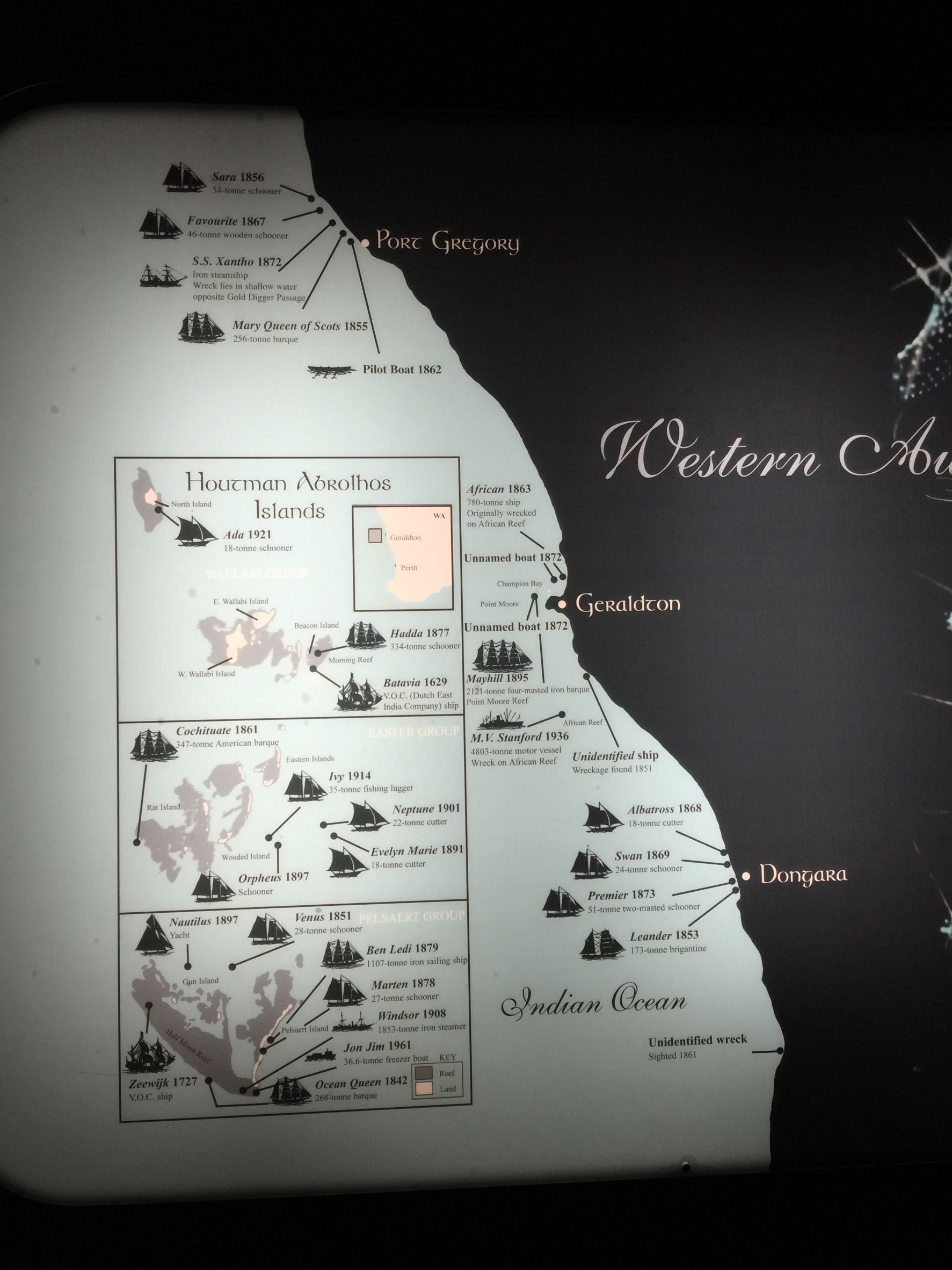
The big attraction at the Geraldton Museum for us was the wreck of the Bativia. We had listened to a podcast about it at home before we left. The Bativia story was interesting and also a horrific story.
In 1629, the Batavia was shipwrecked on Morning Reef on the Abrolhos Islands and what followed was one of the most murderous mutinies in history.

Impressive was the huge replica of stone cargo that was to be used as a grand entrance portico façade in the city of Batavia.

The museum also has a good short movie, timeline and artifacts about the wrecks of SydneyII and Korman in 1941. 


Western Australian coast has many ship wrecks and they are all well documented.
 Staying on the water front closer to the city centre, are egg sculptures, an interpretation of two paintings - The Emu in the Sky by Margaret Whitehouse (Wajarri) and  The Seven Sisters and the Hunter by Barbara Merritt (Badimaya).

Indigenous astronomy saw different shapes in the night sky, emu, 7 sisters and a hunter.

Consisting of eight objects about 1.5 metres in length and covered in bright mosaic tiles, it is a celebration of the rich and cultural heritage of the first people.

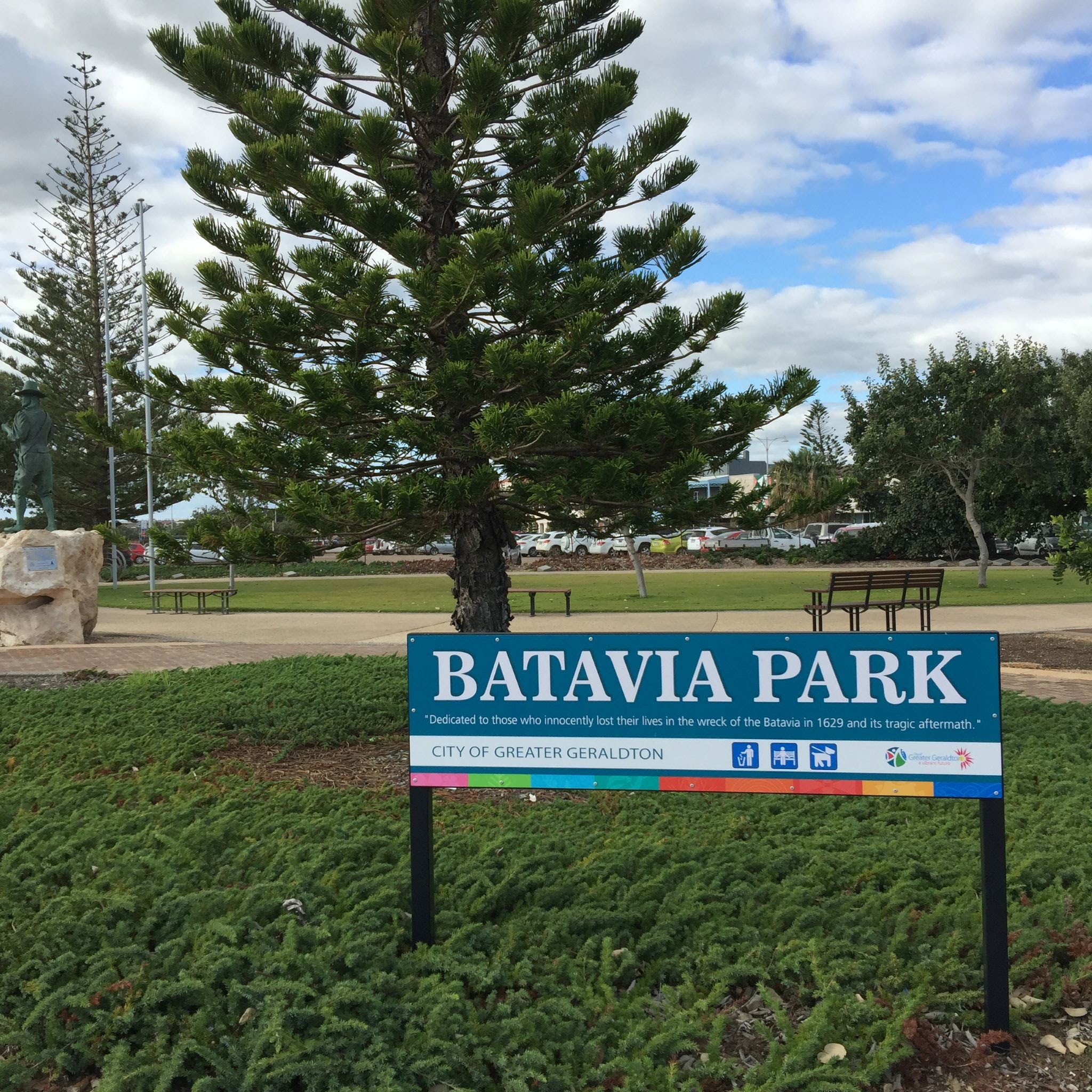
Not far away is Batavia Park and a time line of history of the Geraldton area and its shipwrecks. The park is dedicated to the 200 innocent people lost in the tragedy.

A thin silver line has the engraved dates and a series of plaques that record the history.

The interpretive pathway is an interesting read.

Wiebbe Hayes 'Fort' is Australia's oldest European built structure. Located on West Wallabi Island, Abrolhos Islands. At Batavia Park there is a replica of the fort built in the original form using dry-stone walls that have been modified to make it safer. The original on West Wallabi Island is made of limestone from the reef platforms. The fort was built to defend Wiebbe and his soldiers from the Batavia mutineers.

Moore Point Lighthouse, located south of the town is the tallest metal lighthouse in Australia. Built in 1878, it is 34 metres tall and is an icon of the town.

Many intersections in the town have mini 'Moore Point Lighthouses' located on the intersections

We had lunch at Macca's (Jonnie's choice - I really don't like Macca's new recipes), and we stocked up at Coles before heading back to Coronation Beach. We decided to stay and extra day there as camping on the beach was just so relaxing. We caught up with Gary and Pat who we met in Derby, and prepared some meals to freeze.